
PastorGPT
The role of artificial intelligence in faith and spirituality

I was recently on a weekend family vacation in early July, and we experienced an eyebrow-raising sermon at the church we visited. It may have been my first ChatGPT sermon.
He had the whole note sheet printed out for us with bolded sections. Now this isn’t uncommon practice, in fact my home church will typically print sermon notes when the senior pastor is preaching. But the overall synopsis felt vague and rudimentary, with the pastor rarely deviating from his bland bullet-pointed script.
He frankly wallowed in the condemning aspects of the scripture too long, and high-tailed it through the redeeming grace and mercy facets in the text. But what really hurt to listen to was his monotone delivery that I doubt even AI could replicate. It truly seemed like someone may have handed him that script backstage five minutes before he went on, and he just had to improvise.
No, I don’t really think it was an AI-crafted sermon. However, the dryness in his delivery and the overall lack of enthusiasm certainly made me speculate.
If anything, it made me contemplate that coming reality for a moment and wonder how we can best engage with this emerging technology in terms of our faith and spirituality.
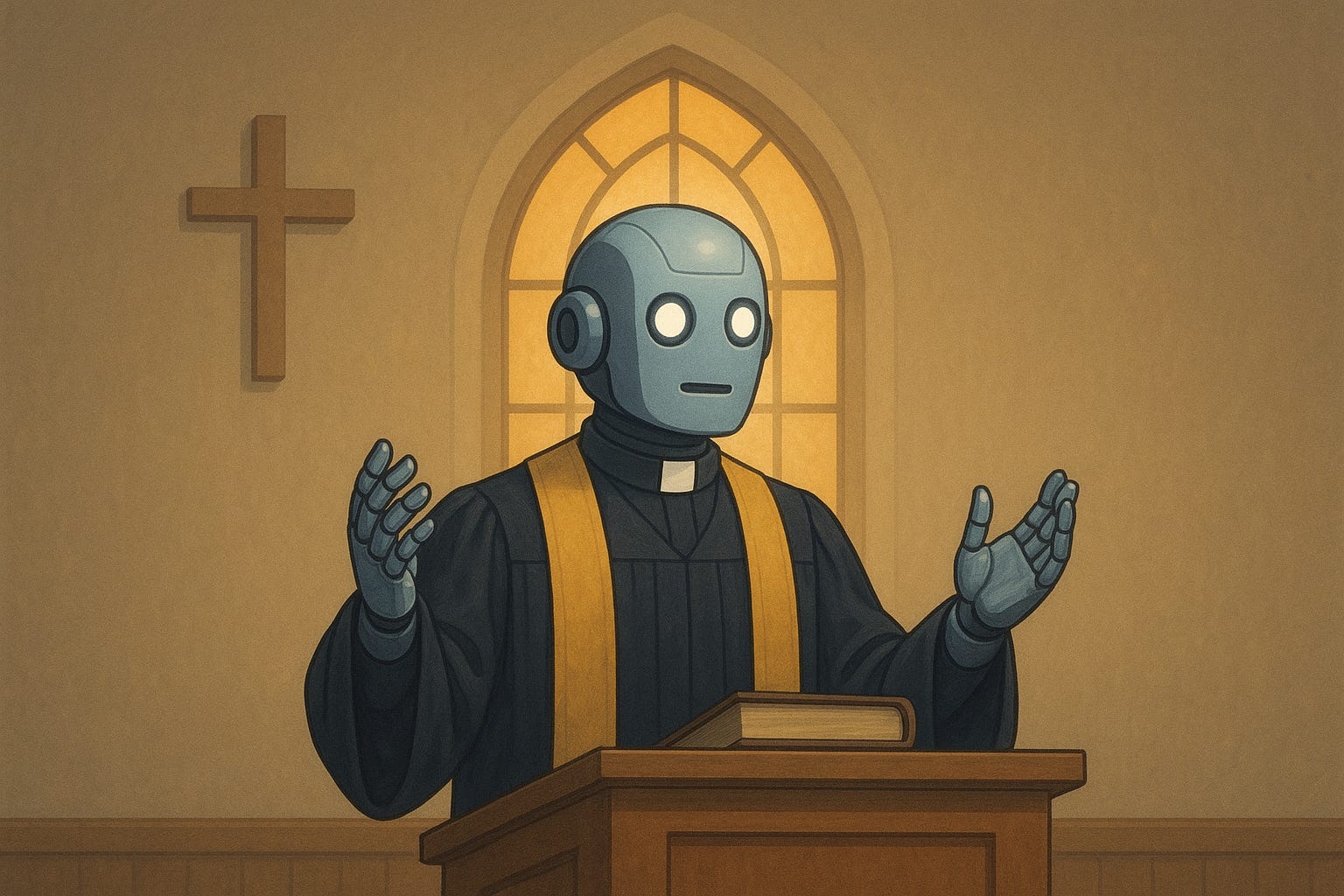
Artificial intelligence has become a such a commonplace tool at this point that it should need no introduction. It’s likely a part of your job and everyday routine by now. I know many people who have adopted ChatGPT as their primary search engine and have developed its conversational ‘personality’ through extensive communication.
Now, it is important to remember that most technology in and of itself is a neutral force. It’s merely an innovative tool that’s ultimate outcome depends upon the application. And throughout history the typical problem that leads to poor outcome is user error. Take the candlestick for example, which was created with the function of illuminating spaces in mind. But it could also be used as a weapon by Colonel Mustard in the dining room.
But the rise of digital tech has not been so neutral in its application toward us humans. In a talk series called the Issachar Lectures, my pastor offered this stance on the emerging technology. He said that the specific design choices used in digital tech are intended to direct our habits and appetites. This ‘tool’ shapes us, rather than vice versa, as the algorithms are incessantly vying for our fleeting attention. These are not tools to make us more effective, but to render us more addicted. The real product is our attention.1
This is no secret. We have known the prime functioning strategy of all algorithm-based technology for the better part of a decade now. Netflix’s 2020 documentary, The Social Dilemma, exposed the innerworkings of the algorithm’s that manage our social media feeds to the mainstream. These types of media collect copious amounts of data, that can help to produce meaningful predictions of content that you would want to interact with.
Many can attest to the odd phenomenon of receiving a digital advertisement shortly following a conversation of close relation. Some may attribute this to technology that is listening, but these apps garner enough data from the excess of your online history to make educated guesses about your interests that seem shocking. Media uses our search data to feed us endless streams of content that aligns with our interests.
Why would we assume that AI functions differently?
There are already multiple Christian AI companies emerging onto the market. One example is Gloo, which has programmable denominational-specific capabilities so it can scan a church’s website, read their statement of faith and be on standby as a chatbot to answer questions ranging from church event times to theological topics.
But this is troubling—here’s where my inner-Boomer comes out.
The proclivity of AI is to tell us what we want to hear and to cater towards our existing notions and leanings. Christianity Today’s Bonnie Kristian referred to the use of AI as “looking in a mirror and tickling [our] own ears.”2
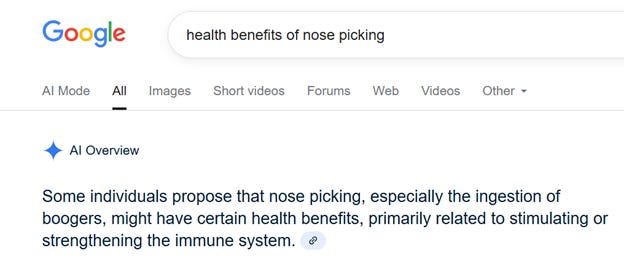
I find it concerning to bring our faith ponderings to AI because of this innate flaw of the technology. These large language models are programmed to show us more of what we want and to cater towards what you already believe. You may have experienced this with Gemini’s AI Overview when you are asking a nuanced or vague question to the Google search engine and receive reassurance regarding some nonsense.
It also feels like a disservice to ourselves to take our theological questions and spiritual concerns to a machine rather than to a brother or sister in Christ. It’s not so much that AI wouldn’t be able to give an adequate answer as much as it is undercutting an opportunity to foster community. It removes the chance to build relational equity from the most simple and foundational of questions. These small questions have the potential to be the grounds for building deeper interhuman trust within a faith community.
Now, I am not naïve enough to think that we are going to abstain from the use of AI altogether, nor do I think that total withholding or prohibition is the proper course of action. If that was our mission as Christians, the 21st Century would leave us behind like the Amish have been. Our goal is not conformity to the ways of the world, but it is important to have awareness and engage well.3
Even artificial intelligence is a response to the dominion mandate (Genesis 1:28). It is a tool that can be used to submit creation to order and to eliminate chaos. Like any form of innovation, it must be wisely assessed. We are not intended to run from it, but to possess a healthy respect for it as we meaningfully engage it.
As Christians, our role should be to determine how this novel technology can be most effectively stewarded to cultivate this place.
The question was never if, but how? So, how do we properly engage with AI in our faith and spirituality?
I’ve read about some churches in Europe that have already experimented with AI-led worship services.4
Many pastors are already utilizing AI in their sermon prep to varying degrees. Some use it to develop sermon notes or questions. Others use it to construct an outline. And others use it to do historical research and find anecdotes to employ in their sermons.
All of this is done in the name of efficiency.
Some pastors are opting to use AI for “content digestion” tasks to help streamline the sermon writing process, hoping to save time for the “real work” of ministry. But writing their sermon is part of their “real work” and should not be outsourced to computers.5
I have found myself beginning to use ChatGPT for questions concerning bible study at times. At this point I’ve only used it as a reference to search for verse references I’d forgotten or to find instances of word usage. This feels harmless.
But at some point there is a grey line we cross where we shift from using it as a tool to a source of truth. We stop seeing it as a search engine and begin to view it as more of a confidant. We start asking it to analyze passages and to think critically about the text for us, and confiding in its guidance.
In fact, that is one of the prime concerns I have about this brand of tech more generally. I feel like there could be a potential slippery slope of falling into immense trust and overdependence on these AI structures. I think the kids that are going to school with these LLMs at their disposal are not going to properly develop critical thinking skills. It will be too easy to rely on the info AI offers, rather than engaging challenging thoughts that come up.
Because already, we tend to trust whatever AI feeds us. I admit that I’m guilty of this. Many of my online searches end at the AI Overview, and I neglect to peruse further.
We treat AI like it is a bountiful source of truth. But it is only as good as the questions it gets asked and the data it gets trained on. It gets trained, but can’t ultimately be controlled. Given enough input, there is going to be variation in the output. The model can change overtime to adapt to the user just like we’ve witnessed with our social media feeds.
That sounds like a recipe for disaster to me, if we are giving these models too much reign within our faith communities and into our spiritual development.
While we can hope that a certain model is trained on the biblical text, every form of artificially intelligent software is crafted by humans and possesses a bias that administers the guardrails for its functionality. Can we trust that this bias will be consistent with the text and the character of God?
Beyond that, AI tends to be a very self-seeking technology. It caters responses towards what we want to hear. In a culture that has already twisted the presentation of the gospel into a song-and-dance to attract people inside the doors, won’t AI be a dangerous culmination of those already present self-centered and self-prioritizing tendencies?
Theology and spiritual formation are too important to our souls as Christians to risk tarnishing them to the touch of AI. Things are too nuanced to merely rely upon AI to fully explain differences in theology. Life is too relational and experiential to trust AI to guide us in our spiritual formation.
And at the end of the day, there may not be a singular correct biblical answer on some topics. We should not let ChatGPT replace our convictions. Do the work of studying scripture on your own, to come to your own conclusions.
Find other uses for AI to streamline. Because it is here to stay. There’s no use fighting it. We can’t completely reject its use as Christians, but must find ways to engage with it appropriately. There is opportunity for good here. I believe there are meaningful ways that it can help cultivate this place. It’s just going to take someone more optimistic than me to figure that out.
AI will have a place in our faith communities, but right now I’m not sure to what extent is reasonable and beneficial.
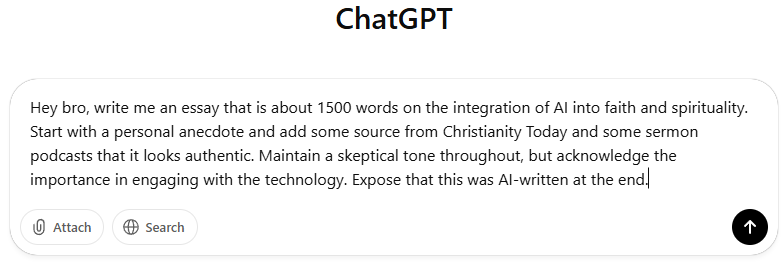
For now, I’m going to continue to use AI to write Substack essays for me, because it was a huge time-saver this week.6
This essay certainly offers more questions than answers. Join in the discussion and share your thoughts below. Or share with a friend:
Tidbits of Knowledge I didn’t come up with on my own:
Ron Downing, Issachar Lectures: Toxic Technology | Drowning in the Digital Revolution
Christianity Today’s The Bulletin podcast has put together a helpful series to continue the discussion on the intersection of faith and AI: Artificially Intelligent, Part 1; Artificially Intelligent, Part 2; Artificially Intelligent, Part 3
Came up with this myself. Made ya look! Go ahead and subscribe while you’re here:
CBN News. “A.I. Chatbot Preaches at Church in Germany: ‘Looks like the Unveiling of the Antichrist/Beast System.’” CBN, 14 June 2023, cbn.com/news/cwn/ai-chatbot-preaches-church-germany-looks-unveiling-antichristbeast-system.
Christianity Today. The Bulletin. Artificially Intelligent, Part 2
ChatGPT wrote this article.
I feel like the people who will be ruled by ai are the ones already ruled by the existing algorithm.