
Kintsugi
a poem: of our brokenness, of His redemption

Kintsugi is a 500-year old traditional Japanese artform of mending broken pottery. The practice finds beauty in restoring the broken pieces together, even drawing attention to the cracks of the pottery. Kintsugi chooses to highlight imperfections instead of hiding or discounting them. The artform emphasizes beauty amidst the broken. Kintsugi is an expression of the larger Japanese philosophy of wabi-sabi that finds beauty in the incomplete and value in simplicity.1
The word Kintsugi effectively means “to join with gold.” The whole restorative process of the artform can take up to three months to complete. First, the broken pieces are carefully glued together using the lacquer from the indigenous Japanese urushi tree. Then, they are left to dry for a few weeks, allowing the lacquer to become tacky. Lastly, a gold powder is sprinkled to adorn the mended cracks. The restored piece of pottery stands as a testament to the beauty in embracing human imperfections.2
In a world that is quick to hide our scars and cover up our flaws, Kintsugi stands as a counter-cultural practice reminding us of our inherent brokenness as humans, and even celebrating the beauty that can be restored there.
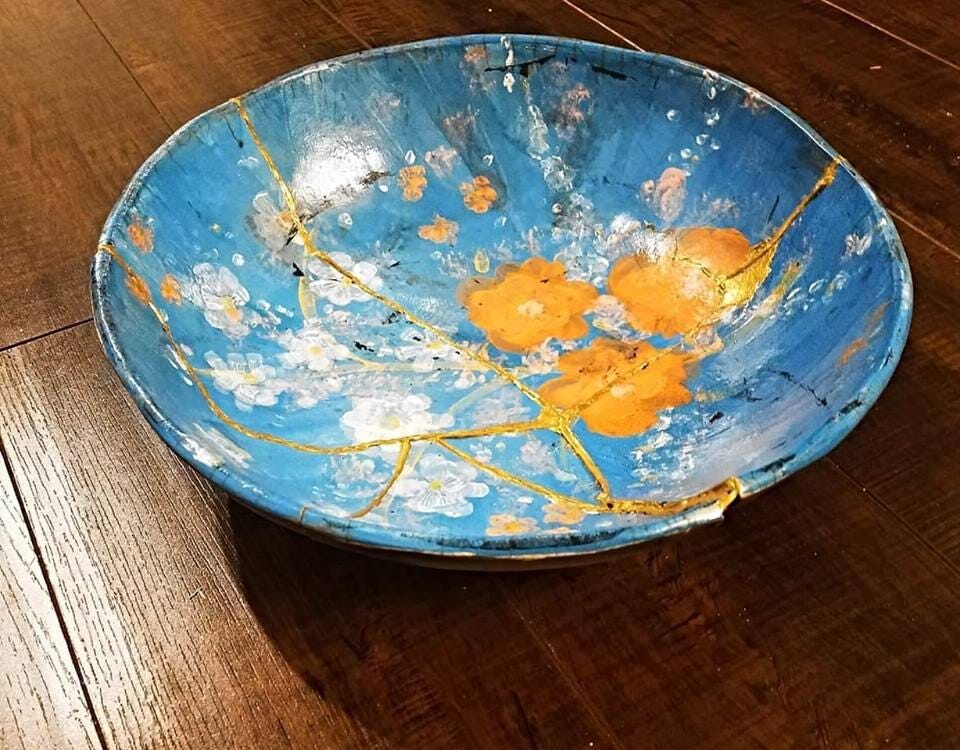
When I heard about the practice of Kintsugi, it reminded me of God’s redemptive work with humanity. He only has broken pieces to work with. And like Kintsugi artists God has a plan to restore beauty to the brokenness.
God does not cover or hide the broken parts of us. He chooses to work in our lives in spite of our brokenness, highlighting those flaws to his own glory.
In fact, all he has to work with is broken pieces. The Church is a conglomeration of broken vessels that God is restoring.
I hope this imagery helps you develop empathy for others, and gratitude toward God’s redemptive work in our lives. Enjoy!
Kintsugi
What broken vessel here once lay,
Shattered pieces in disarray—
Without form, mere jagged edge—
Futile in most every way?

Were not a potter’s hand to sculpt,
Restoring essence to the full’st
By mending each lone jagged edge,
To reinvigorate what dulled?

Had that porcelain e’er not shone
In the vibrance it now beholds,
Glimm’ring along the jagged edge,
Both worth and image now of gold?

What restored vessel purposed through
Christ’ning oil pervading into
And cascading o’er mended edge,
Excess abundance apt to prove
This was made for honorable use?
Oh, to be made for honorable use!
Sho, Terushi. “Kintsugi: Japan’s Ancient Art of Embracing Imperfection.” BBC News, BBC, 25 Feb. 2022, www.bbc.com/travel/article/20210107-kintsugi-japans-ancient-art-of-embracing-imperfection.
Ibid.
ok fire.
Japan been sitting on a sermon metaphor treasure trove 🫢 love the analogy Brandon!